

UCL article – Where we love: how we rebuild Britain from the bottom up
As UCL Policy Lab and Locality work together to develop ways to help communities build sustainable more connected places, James Baggaley visits Witton Lakes Eco Hub to hear about the work going on to deliver real change.

Credit – UCL / Jørn Tomter
“We’re in a little oasis, aren’t we?” Linda says to me from across the table, cup of tea in hand, “We can’t alter what happens in Trump’s head or anyone’s head. But we can do our little bit, in the place where we love.” She leans forward, as if to make sure I get the point: “It’s the ‘where’ we love that matters.” Linda says.
From someone else, I might take this as hollow words, schmaltz, the kind of ‘hopey-changey’ language the world seems to have little time for these days. But from Linda, every word comes with the weight of hard work, for her community, her neighbourhood, the place she loves. Thirty-six years of hard work to make her place the best it can be.
We’ve spent the morning with Linda at the Eco Hub, built by the Witton Lodge Community Association in Perry Common, Birmingham. Along with Afzal Hussain and Jo Townsend, Linda has been showing us around the neighbourhood and the work they’ve been doing together, as a team and as a community.
In every story of community turnaround, there are heroes – leaders who have discovered ‘it’ within themselves, a special force that has helped them and their community. Linda is one of those. And yet, as she makes clear throughout our visit, she’s just one of many, a network of folks who have stood up for the “place they love.”
When we arrive in Perry Common a community a short drive from the shiny office blocks of central Birmingham I’m met by Afzal Hussain. Quietly spoken, in a neat blazer, he has a gentle manner. He begins to tell us how the work started.
Perry Common, the estate at the heart of the community, began life as housing for working-class families escaping the slum conditions of industrial Birmingham. Built in the 1920s using faster building techniques, those same methods led to severe structural defects.
By the late 1980s, Perry Common’s concrete-framed homes were crumbling, damp, and dangerously unstable. In 1989, over 900 families were told their homes would be demolished — yet no funding existed to rebuild, leaving the community in crisis.
Residents formed an association that helped build a new vision for the area. Inspired by the Stockfield Community Association, eight locals established Witton Lodge Community Association (WLCA), which went on to lead revitalisation efforts — including the building of new homes, led by the community. From there, the association refurbished Perry Common Community Hall in 2010.
Credit: UCL / Jørn Tomter
As Afzal finishes telling us how we got here, Linda appears from behind him — much shorter, with narrow glasses with a slight tint. She grabs my hand and welcomes me: “Great to see you. Welcome to Birmingham, welcome to Perry Common.”
Linda tells me how she got involved in the work over three decades ago, when her family’s house was scheduled for demolition.
“My first meeting was 21st July 1991, in that room, in the living room of my neighbour — and that was the trigger that saved my life,” she says, looking back. “If it wasn’t for this project, I would still be shy, unconfident, not challenging, and just taking what we were given.”
This moment marked the beginning of her journey from a quiet, uncertain resident to a confident leader in her community.
Linda is someone I recognise. We’ve never met, but I’ve met women like her. I grew up among women like Linda — women who got things done. They watched the street, made sure kids were in school. They were watchers, able to sense when and if to reach out. They were like a force of nature — they were aunties and nans to everyone.
What Linda has built with her neighbours now goes far beyond the initial community-led housing. As well as being a social landlord offering affordable, good-quality, and green homes, the association has expanded to support the community with health, wellbeing, and connection.
Today we’re here to see the latest addition. Opened in 2022, Witton Lakes Eco Hub is built around a former park keeper’s cottage, now transformed into an eco-friendly community facility.
“These lakes,” Linda says, pointing to the former city reservoir, “had become hot spots for crime and rubbish.” The new local MP, who recently met with Afzal and Linda, recalled a time when, as a community nurse, she parked to see a patient, only to have someone steal her car and dump it in the lake.
“She was blown away when we gave her the tour — the turnaround from the place where her car had been dumped to what it is now.” Linda says.
As we walk along the path, Linda and Afzal greet residents, noting the best places to spot the now-thriving wildlife. “Just here you’ll often see the ducks and their feeding, you know? There’s magic, but you’ve got to look for it,” she says, pointing along the bank.
It started with Linda and locals doing litter picking and “duck watch” to help support the wildlife on the lake. But they soon built momentum for bigger change…
“The first proper bit of work we did was the planting of the orchard. I saw an advert on the back of a toilet roll pack, saying they plant a tree for every 100 sold. And so, I wrote to them.” She says with pride.
Sure enough, she got the toilet paper company to plant the trees. The orchard is rich with apples and pears when we visit. A family from the local estate are picking apples – a free but special day out for the kids.
From these trees, the scheme grew. Now the Eco Hub and community centre sit at the heart of the lakes. As Afzal makes clear, it’s not just about providing folks with a space to escape the stresses of life, the cost of living, or the doomscrolling of social media, it’s also a place where people can connect with nature, wellbeing, and learn how to save energy.
“It’s all about doing health, well-being by stealth,” Afzal explains.
“And it’s also about recognising that you help people save energy by showing the way. Our scheme here has saved some carbon, sure—but we’ve helped countless families learn about ways they can cut their energy bill or fix up an appliance in the Makers Yard.
Ed Wallis from Locality – the national membership network for community organisations like Witton Lodge Community Association – thinks the Eco Hub has big implications for politics.
“We live in a time of plummeting political trust and our national commitment to net-zero is being contested. Witton Lodge Community Association’s work is a brilliant example of how we can bridge the gap, connecting people’s everyday experience of their neighbourhoods to wider climate challenges. There are thousands of organisations like this all round the country – we need to recognise them as a critical source of hope.”

Credit: UCL / Jørn Tomter
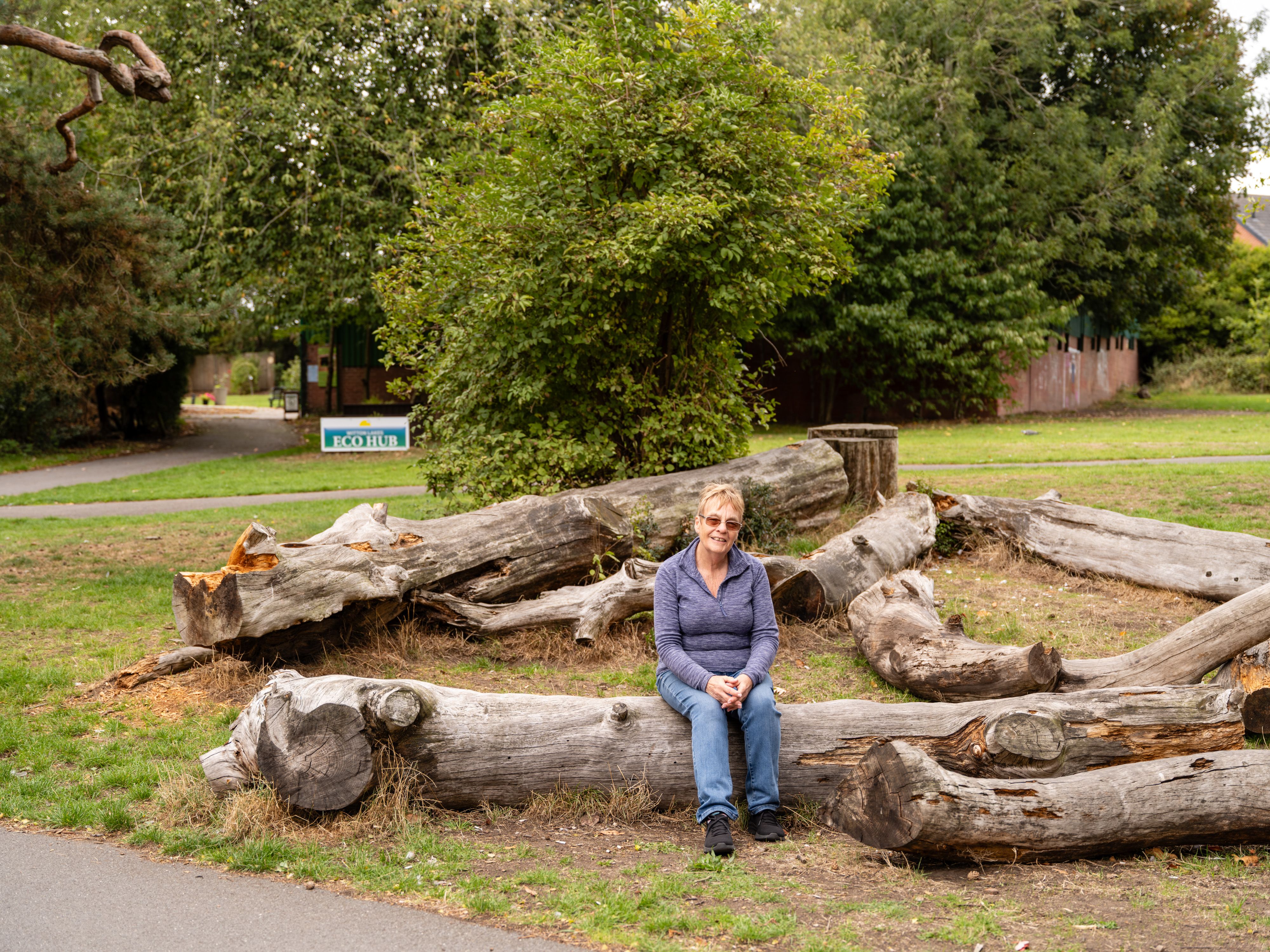
As Afzal explains the thinking behind it, Linda points over to some big logs being used by a lady to sit and rest. “Those tree stumps came down in one of the storms. And I said to the council, ‘Please just cut it up and leave it,’ because I knew people would use it.”
Sure enough, it’s become exercise equipment and a place for the local ladies’ walking group—”The Red Hot Chilli Steppers” to meet.
Throughout the day, Linda keeps coming back to some core principles about why the project has worked and why the community is benefiting. Firstly, it’s about responding to what people need:
“We listen and ask, constantly trying to work out what we need as a community and acting on it.”
I think of all the top-down Whitehall schemes to turn around neighbourhoods – he failed regeneration projects and targets. In stark contrast here in Brimingham small amounts of money have been treasured by people who know the worth of every pound.
Secondly, it’s having a sense of place and connection to the uniqueness of this community. The ideas and things that work here aren’t the things that will work everywhere b ut that’s fine. The scale and capacity to adapt are central to the success and impact.
As Linda puts it: “We know our people, and we know our place.”
Thirdly, and perhaps most importantly of all, it’s built on relationships. Throughout the day, Linda and Afzal discuss the people they meet and how they build connections between them and the project.
As Linda puts it: “It’s about the relationships, built through small human interactions that enable us to do so much. Those relationships we build help us make change every day, and those are the things that really make a difference and really matter,” she says as we wander back to the community space, now filling up with families. The place is flooded with conversation and smiles.
I’m reminded of a recent visit by the community organiser, Professor Hahrie Han. In her work on organising and politics, she spoke about how we are “more likely to take action if a relationship exists,” and that “the perfect message is the imperfect message coming from a neighbour you already have a trusting relationship with.”
Here in Birmingham, in a small community far from the cockpit of power, a community, neighbourhood, is putting those kinds of ideas into action. From the big to the small, it’s rebuilding trust to make their bit of Britain the best it can be.
Read the original article HERE